
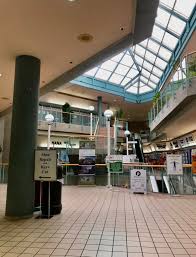
 Although University Heights Mall is no longer what it was more than five years ago, if not a decade, the new façade of tall, looming structures stacked over lived-in space feels sterile and uninviting. What replaced it lacks the charm I grew up with: the roundabout staircases, the awkward corners, the small-town feel that made the mall feel human. No, I’m not asking to live forever in some nostalgic loop, but when news broke that the property had been sold to an American firm, my heart sank for good reason.
There used to be smaller brunch spots and a sense of community here, back when Gauntlet Games occupied the space. These were places run by people you recognized, places that felt rooted. Now, as glass-and-concrete buildings near completion and independent eateries quietly vanish, the corporate blueprint becomes impossible to ignore. What made this area distinct is being flattened into something efficient, repeatable, and ultimately disposable. When local businesses are replaced almost entirely by franchise food operations, the direction isn’t subtle. The decision has already been made.
With the arrival of Kinton Ramen, Chipotle, and Ono Poké & Grill in the new centre, brand loyalty replaces discovery. Fans of these names know exactly what they’re getting before they arrive, which is precisely the point. These operations anchor the ground floor, apartment towers stacked neatly above them, creating a self-contained ecosystem where residents are encouraged to spend without ever leaving the building. The smell of hot food drifting upward isn’t accidental; it’s part of the design.
 Dave’s Hot Chicken and Firehouse Subs are now open, and people are showing up in numbers. They’re also paying the price, literally. Dave’s, in particular, is already earning a reputation for being expensive. Twenty-four dollars gets you two pieces of chicken and fries. No drink. No apology. At that point, I’d rather walk a block and get Popeyes and keep the change.
I did try their sliders, which are undeniably large. The mild heat was flavourful without being punishing, and the fries are the real win here. Twice-fried, crispy when hot, possibly seasoned with rock salt instead of the usual fine grain. That crunch matters. I’d rate the fries close to four stars. The chicken itself lands closer to a three, which makes the pricing harder to justify.
Although I haven’t yet visited Firehouse Subs, having only opened last week, my expectations are modest. A submarine sandwich lives or dies on what makes it different, not on branding alone. This operation may simply slide into the space once occupied by Quizno’s since that building across the street used to house that operation. This franchise once blanketed Vancouver Island. Whether Firehouse lasts will depend less on loyalty and more on lease agreements and foot traffic. That’s the reality of corporate-managed properties.
About Time, or Do They Need an About-Face?
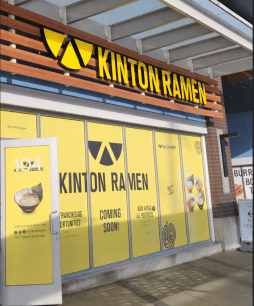
Kinton Ramen was one of the earliest indicators that this redevelopment wasn’t about nurturing local food culture, but about importing proven systems. Although it’s a Toronto-based brand, its rapid expansion across North America has made it a safe bet rather than a bold one. The bowls are consistent, rich, and filling, and unlike most mall foods, ramen requires you to sit down and stay awhile. That does change the energy, even if the decision to bring it in was anything but organic.
Chipotle needs little explanation. It’s assembly-line efficiency, predictable portions, and a customer base trained to order before reaching the counter. Whether that feels comforting or soulless depends on your tolerance for uniformity.
Ono Poké & Grill fills a strategic gap. Lighter food, faster turnover, customizable bowls, and a health-adjacent image that plays well in developments like this. Poké has become almost mandatory in modern retail builds, less a choice than a checkbox. Its presence keeps the lineup from appearing too indulgent, even if the calculation behind it is obvious.
What’s happening at University Heights Mall isn’t accidental and it isn’t grassroots. These are franchise operations with built-in audiences, predictable margins, and centralized decision-making. From a landlord’s perspective, it’s safe and scalable. From a diner’s perspective, it offers familiarity at the cost of character.
Overall, University Heights Mall is becoming a food hub, but not necessarily a community one. Some of these places I’ll visit again. Others I won’t. What’s changed is that eating here now feels less like discovery and more like participation in a system designed elsewhere. The debate is no longer about what’s good, but about what we’ve traded away to get it.
 twohungryblokes.com