
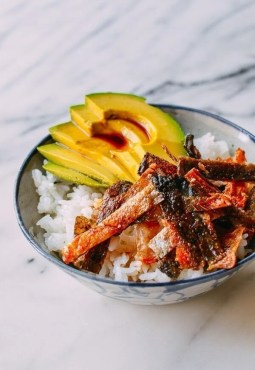
 With H-Mart still the talk of the town in Victoria and a place I regularly visit, the first thing that always catches my eye is the sheer variety of flavoured fish skins now lining the shelves. Although they’ve been around for ages, seeing them in local markets still feels novel. Before, you’d have to trek to your friendly neighbourhood international district or a mom-and-pop shop that specialised in snacks from “back home” rather than ones made in America. Even Fairways dabbled in selling them once, but they never quite took off—probably because they’re an acquired taste. And considering they don’t come cheap (which is ironic, really, for what was once a throwaway part of the fish), not everyone’s going to take kindly to snacking on this particular piece of flesh.
They’re not really comparable to bacon—though the crunch might trick you at first—and maybe they sit somewhere closer to a very oily, sea-scented potato chip. Because they’re greasier than most fried snacks, I’ve found they work better as a topping than as a standalone indulgence. A few pieces sprinkled over a bowl of rice? Surprisingly satisfying. I’ve even tried tossing them onto ramen for texture, but the result was just… okay. Let’s just say they’re not destined to become a pantry staple for my weeknight dinners. They’re rich, indulgent, and definitely not waistline-friendly. Still, for those who haven’t crossed paths with Korean or Southeast Asian junk food before, a little backstory makes the trend make a lot more sense.
The Origins: From Scraps to Superstar
 Historically, fish skin wasn’t considered garbage across Asia. Thrifty cooks knew better. It was used as crispy garnishes in Chinese hotpot, added as a savoury layer in Japanese sushi, and fried into golden bites in Southeast Asia long before anyone thought to market it. It was flavourful, fatty, and packed with omega-3s—practical, but never glamorous. Then came Singapore’s salted egg yolk craze, and everything changed.
Around 2017, a small company called IRVINS struck gold—literally—with their salted egg fish skin crisps. Each piece was coated in rich yolk crumble and dotted with curry leaves, transforming the humble by-product into airport gold. Travellers queued for boxes. Suitcases were stuffed. Soon after, The Golden Duck and countless regional competitors followed suit. Now, even mainstream U.S. supermarkets stock them in every flavour imaginable—truffle, kimchi, Thai chili lime. What was once waste had suddenly become luxury.
Why the Craze Makes Sense
And honestly? It makes sense. These things hit every sensory note just right: crunchy but airy, rich yet briny, salty with just enough sweetness to keep you reaching for another piece. But there’s something deeper behind their appeal. In a world obsessed with “clean” eating, fish skin feels delightfully rebellious—edgy, even. It taps perfectly into two modern obsessions: sustainability, with its “nose-to-tail” food ethos, and novelty, with its irresistible Instagrammability.
But… Are They Healthy?
 Of course, like all great snacks, the nutritional halo is a bit of a mirage. A 50-gram pack typically brings in about 10 to 12 grams of protein and some omega-3s, but also roughly 300 calories, 20-plus grams of fat, and 400 to 600 milligrams of sodium. They’re basically chips with better branding. Delicious, but not something to pretend is health food. Let’s be honest: this is comfort food for people who want their indulgence to crunch.
DIY Fish Skin: The Hacker’s Version
Still, if the $9 price tag gives you pause, there’s a fun workaround. Salmon skins are often free for the asking at your local fishmonger—just dry them well and toss them into an air fryer. Coat them in a buttery mash of salted egg yolks and curry leaves, and you’ve got a homemade version that rivals the pros.
Quick Method:
- Air fry at 180°C (350°F) for 8–10 mins.
- Coat with salted egg yolk + butter mixture.
- Cool, crunch, and wonder why you ever paid retail.
Cultural Redemption Story
 But what really fascinates me about the fish skin craze isn’t just the flavour—it’s the story. This was once a scrap, a kitchen leftover destined for the bin. Now it’s wrapped in matte designer packaging, featured in airport displays, and devoured by influencers. That’s not just clever marketing; that’s a full-on cultural redemption arc. In a food world where waste is out and reinvention is in, fish skin has become the poster child for turning the overlooked into the irresistible.
Final Crunch
So when someone scoffs and asks, “You really paid ten bucks for fish skin?” just smile, tear open that glossy pouch, and let them try one. Because if the past few years have proven anything, it’s that with enough salted egg yolk—and a little imagination—even the most unglamorous scraps can find their moment in the spotlight.
 twohungryblokes.com